

At a Glance: Trehalose for Autophagy & Cellular Cleanup
- What It Is: Trehalose is a natural disaccharide found in mushrooms, yeast, and resurrection plants. In human cells, leveraging trehalose for autophagy offers a unique way to clear metabolic debris.
- The Core Mechanism: Unlike standard starvation or caloric restriction, using trehalose triggers deep cellular degradation through an mTOR-independent pathway by modulating solute transporters and activating Transcription Factor EB (TFEB).
- Key Health Benefits: In addition to supporting cellular cleanup, it clears misfolded neurotoxic proteins (tau, alpha-synuclein), protects brain mitochondria, and preserves lean muscle during detox protocols.
- How to Use It: Effective clinical protocols range from 5 grams to 15 grams daily, which can be combined with dietary fasting windows to maximize health benefits.
Understanding how to leverage trehalose for autophagy has revolutionized natural health protocols aimed at cellular renewal and brain protection. For decades, health seekers and functional medicine researchers have known that calorie restriction and extended water fasting stimulate cellular autophagy—the self-cleaning process where damaged organelles, oxidized proteins, and cellular waste are recycled into fresh energy. However, prolonged fasting is not always practical or therapeutic for individuals dealing with adrenal stress, thyroid challenges, or midlife muscle loss.
Fortunately, scientific research indexed by the National Institutes of Health (NIH) reveals that trehalose triggers robust autophagosomal clearance in neurons, heart tissue, and liver cells. Specifically, it activates cellular recycling without requiring nutrient deprivation or deactivating the nutrient-sensing mammalian target of rapamycin (mTORC1). In this deep-dive guide, we examine how trehalose for autophagy functions at the cellular level, how it shields neurons from degeneration, and how to safely integrate it into your personal wellness routine.
The Science Behind Trehalose for Autophagy and mTOR-Independent Renewal
To appreciate why trehalose is so unique, it helps to compare it with traditional cellular recycling. In standard fasting-induced autophagy, nutrient deprivation drops intracellular glucose levels. Consequently, this signals mTORC1 to pause cell growth so that cellular waste digestion can begin.
Although highly effective, chronic mTOR suppression can sometimes lead to muscle loss, lethargy, or hormone disruption. On the other hand, trehalose activates cellular cleanup through a distinct, gentler mechanism. As documented in Science Signaling research, trehalose transiently restricts glucose uptake through GLUT solute transporters. As a result, the cell senses a mild localized energy signal, which causes Transcription Factor EB (TFEB)—the cell’s master cleaning controller—to translocate into the nucleus and initiate lysosomal cleanup.
When trehalose enters circulation, it temporarily modulates cellular sugar transport without altering overall systemic blood sugar levels. Therefore, TFEB moves directly into the nucleus to construct new lysosomes. Consequently, your body clears damaged protein aggregates efficiently while preserving muscle protein synthesis and metabolic energy.
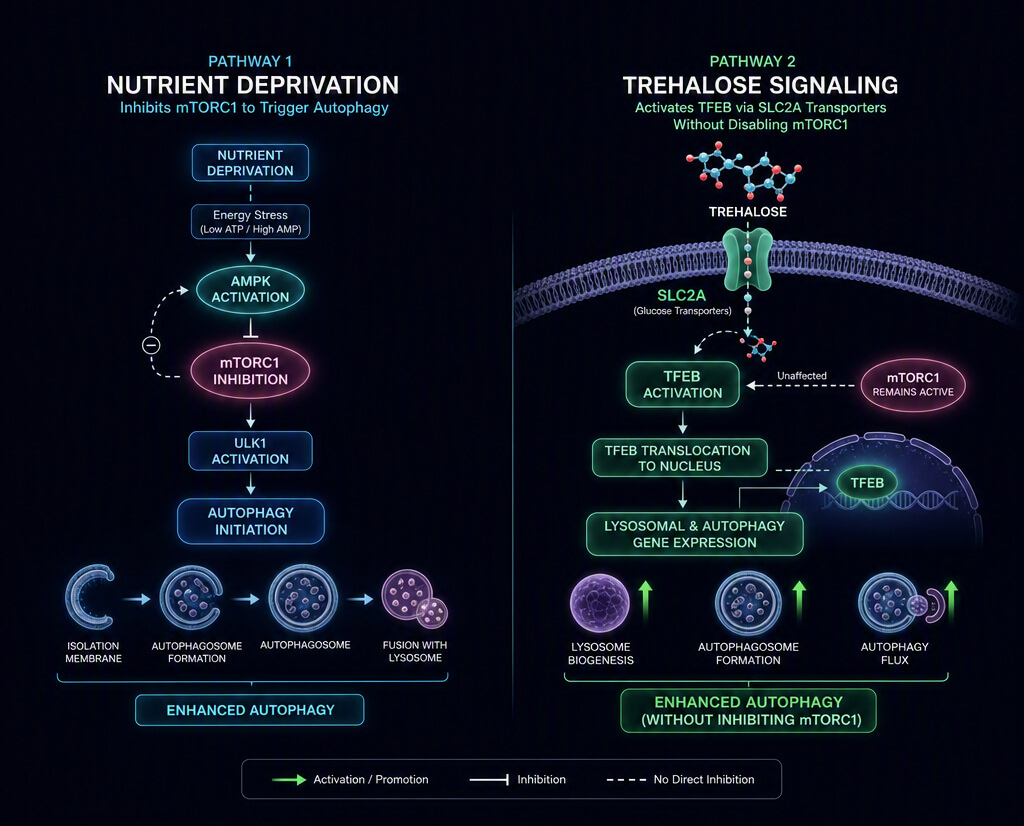

Comparing Cellular Cleanup Pathways: Fasting vs. Trehalose
| Feature | Fasting-Induced Autophagy | Trehalose-Induced Autophagy |
|---|---|---|
| Primary Regulator | mTORC1 Inhibition & AMPK Activation | TFEB Nuclear Translocation |
| Systemic Caloric Impact | Requires zero caloric intake | Operates alongside normal food intake |
| Impact on Muscle Growth | Suppressed during fasting window | Preserved (mTOR remains functionally active) |
| Target Debris | General non-selective autophagic flux | Selective clearing of aggregates & protein clumps |
Using Trehalose for Autophagy to Support Neuroprotection
One of the most valuable applications of using trehalose for autophagy lies in supporting central nervous system health. Because long-lived neurons do not divide frequently, they are vulnerable to the accumulation of misfolded proteins. Over time, toxic protein aggregates accumulate inside nerve cells, obstructing cellular transport, damaging mitochondria, and triggering inflammation.
In fact, scientific studies featured in Cells Journal on neurodegeneration demonstrate that trehalose readily crosses the blood-brain barrier. Furthermore, it enhances glymphatic clearance and neuroautophagy by systematically degrading:
- Alpha-Synuclein: Insoluble protein fibrils responsible for nerve cell stress and motor impairment.
- Hyperphosphorylated Tau & Amyloid-Beta: Sticky protein deposits implicated in memory loss and cognitive decline.
- Huntingtin Protein: Polyglutamine expansion proteins that cause accelerated cellular damage.
Therefore, by hyper-activating internal lysosomal degradation units, trehalose functions as a molecular chaperone that protects structural brain integrity and promotes mental clarity.
Combining Trehalose for Autophagy with Complementary Longevity Compounds
Although trehalose works exceptionally well as a standalone nutraceutical, its therapeutic potential increases exponentially when combined with complementary autophagy inductors. For example, in natural longevity protocols, pairing trehalose with polyamines creates a highly effective dual-action pathway:
The Dual-Pathway Synergy Protocol
- Spermidine Support (EP300 Inhibition): First, spermidine activates mitophagy by inhibiting the EP300 enzyme, which tags old cellular debris for removal.
- Trehalose Activation (TFEB Translocation): Meanwhile, trehalose simultaneously drives nuclear TFEB translocation, ensuring the cell manufactures sufficient functional lysosomes to digest the debris mobilized by spermidine.
- Urolithin A Integration (Mitochondrial Renewal): Finally, adding Urolithin A for mitophagy ensures that aging, dysfunctional mitochondria are selectively targeted and recycled into fresh energy.
As a result, this multi-targeted strategy ensures that cellular waste is not only tagged for destruction but efficiently broken down and safely eliminated without overwhelming systemic detox pathways.
How to Use Trehalose for Autophagy: Clinical Dosing & Guidelines
When introducing trehalose for autophagy into a wellness routine, proper dosage and gut tolerance titration are crucial. Because human enterocytes express varying levels of the enzyme trehalase (which breaks down trehalose in the small intestine), gradual administration ensures optimal digestive comfort.
1. Step-by-Step Titration Schedule
- Week 1 (Introductory Phase): Consume 5 grams (approx. 1 level teaspoon) of pure trehalose dissolved in warm water or herbal tea once daily with morning food.
- Week 2 (Therapeutic Phase): Increase to 10 grams daily (5 grams morning, 5 grams early afternoon).
- Week 3+ (Advanced Protocol): Scale up to 15 grams daily for concentrated 30-day cellular reset cycles.
2. Supporting Detox Pathways
In addition to taking trehalose, it is critical to ensure your body’s elimination routes remain open. Because accelerated cellular cleanup liberates trapped waste into circulation, review our comprehensive Drainage Funnel Protocol to confirm hepatic, biliary, and lymphatic pathways are functioning optimally.
If you experience mild fatigue or Herxheimer-like reactions upon starting trehalose, it indicates rapid debris liberation exceeding your lysosomal clearance or binder capacity. Therefore, pair your protocol with targeted cellular binders from our Natural Health Shop to safely encapsulate mobilized waste in the digestive tract.
Unlocking Longevity and Health Naturally
Ultimately, integrating trehalose for autophagy provides an effective bridge between scientific innovation and natural health practice. By harnessing TFEB activation and non-mTOR dependent cellular recycling, you can support brain clarity, mitochondrial turnover, and systemic longevity without subjecting your body to extreme caloric stress.
Whether you are recovering from chronic fatigue, supporting neurological resilience, or refining a comprehensive healthy aging protocol, trehalose stands out as a gentle yet remarkably effective tool for lasting cellular renewal.
Peer-Reviewed Scientific References & Studies
- Sarkar, S., et al. (2007). Trehalose engages a novel, mTOR-independent pathway to induce autophagy and clearance of mutant huntingtin and alpha-synuclein. Journal of Biological Chemistry, 282(8), 5641-5652. PubMed Study PMID: 17182613
- DeBosch, B. J., et al. (2016). Trehalose inhibits solute carrier 2A (SLC2A) proteins to induce autophagy and prevent hepatic steatosis. Science Signaling, 9(416), ra21. PubMed Study PMID: 26912581
- Palmieri, M., et al. (2011). Characterization of the TFEB cistrome reveals its transcription is regulated by autophagy demand. Human Molecular Genetics, 20(19), 3852-3866. PubMed Study PMID: 21712392
- Rusmini, P., et al. (2019). Trehalose induces autophagy and clears protein aggregates in neurodegenerative disease models. Cells, 8(10), 1241. PubMed Study PMID: 31608241
- Zaarur, N., et al. (2014). Proteasome failure promotes TFEB nuclear translocation and lysosomal biogenesis in an mTOR-independent manner. Molecular and Cellular Biology, 34(14), 2720-2734. PubMed Study PMID: 24820415