

📌 At a Glance: Clinical Binder Selection
- Prevent Recirculation: First, binders physically capture toxins in the GI tract to prevent enterohepatic recirculation once your Drainage Funnel Pathways are open.
- Toxin Affinity Matters: Consequently, no single binder removes every compound. Charcoal adsorbs broad chemicals, Zeolite traps heavy metals via ion exchange, Bentonite clay binds mycotoxins, and Modified Citrus Pectin (MCP) provides systemic chelation.
- Strict Clinical Timing: As a result, you must always space binder doses at least 120 minutes away from food, supplements, and medications to avoid nutrient stripping.
Welcome to our comprehensive binder hierarchy comparison guide, designed to help you select the precise clinical binder for your specific detoxification needs. In the world of holistic health, binders act as the ultimate cleanup crew. While establishing an open Drainage Funnel Protocol ensures your elimination pathways are draining, binders physically capture heavy metals and environmental toxins in the gut before reabsorption occurs.
However, a frequent setback in protocol design is treating all binding agents as identical. Specifically, each binder possesses a distinct chemical affinity and physical mechanism. Consequently, matching an incorrect binder to a target compound is like attempting to pick up wood with a magnet.
Furthermore, using this binder hierarchy comparison guide allows practitioners to match exact biochemical mechanisms to individualized patient needs for maximum safety and efficacy.
The Master Binder Hierarchy Comparison Table
| Binder Type | Primary Target Toxins | Mechanism of Action | Best Clinical Use Case |
|---|---|---|---|
| Activated Charcoal | Acute chemicals, pesticides, herbicides, endotoxins (LPS) | Adsorption: Toxins cling to a massive carbon surface area. | Acute chemical exposure, GI upset, Herxheimer flare control. |
| Zeolite (Clinoptilolite) | Heavy metals (Pb, Hg, Cd), ammonia, histamine | Ion Exchange: Cages positively charged cations inside a crystalline honeycomb structure. | Systemic heavy metal clearance and gut wall preservation. |
| Bentonite Clay | Mycotoxins (mold), ochratoxin A, aflatoxins | Electrical Charge: Negative surface charge draws negatively/positively charged fungal toxins. | CIRS, toxic mold recovery, and soothing hyper-permeable mucosa. |
| Modified Citrus Pectin (MCP) | Systemic lead, mercury, arsenic, Galectin-3 | Blood Chelation: Low-molecular-weight polysaccharides cross the gut barrier into systemic circulation. | Deep tissue heavy metal chelation and cardiovascular cellular care. |
📩 Get Free Clinical Detox & Protocol Updates
Subscribe to receive our latest natural health research, binder timing guides, and cellular drainage protocols delivered directly to your inbox.
Applying the Binder Hierarchy Comparison Guide
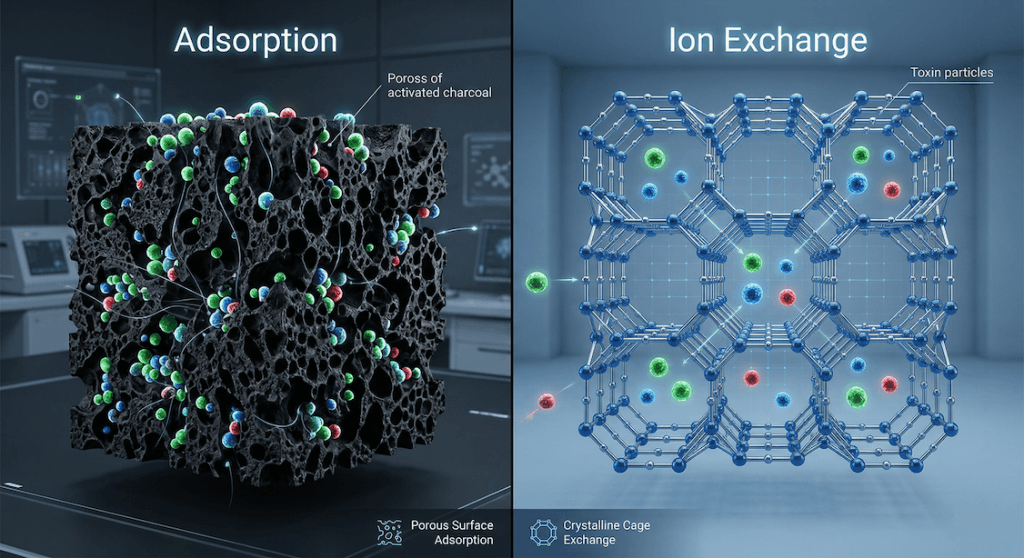
Understanding the physics of detox: How distinct molecular structures sequester toxins for excretion.
1. Activated Charcoal in the Binder Hierarchy Comparison Guide
Activated charcoal remains a trusted baseline adsorbent due to its massive porous surface area. Consequently, it easily attracts organic chemicals, pesticides, and microbial lipopolysaccharides (LPS) in the digestive tract. However, because charcoal is non-selective, continuous use without breaks can pull vital minerals like zinc and magnesium from tissue stores.
2. Micronized Zeolite: Cationic Ion Exchange
As documented in modern clinical studies indexed on PubMed and our analysis of Zeolite Gut Barrier Research, clean Clinoptilolite is ideal for heavy metal sequestration. Specifically, Zeolite features a negatively charged honeycomb structure that securely cages positively charged ions like lead and mercury without removing essential minerals.
Additionally, for light metals like aluminum, consider combining zeolite with targeted silicon protocols as outlined in our Silica Binders for Aluminum Detox Guide.
3. Bentonite Clay: Fungal Mycotoxin Sequestration
Bentonite clay is particularly effective for individuals addressing mold illness and Chronic Inflammatory Response Syndrome (CIRS). In addition, its layered structure swells in water, forming a protective barrier along the gut mucosa while pulling hydrophobic toxins like ochratoxin A into its matrix.
4. Modified Citrus Pectin (MCP): Systemic Tissue Clearance
Unlike standard binders that remain strictly inside the gut lumen, Modified Citrus Pectin contains low-molecular-weight polysaccharides. As a result, these active fragments cross into systemic blood circulation to chelate heavy metals directly from deep tissue stores.
The Golden Rule: The 2-Hour Window
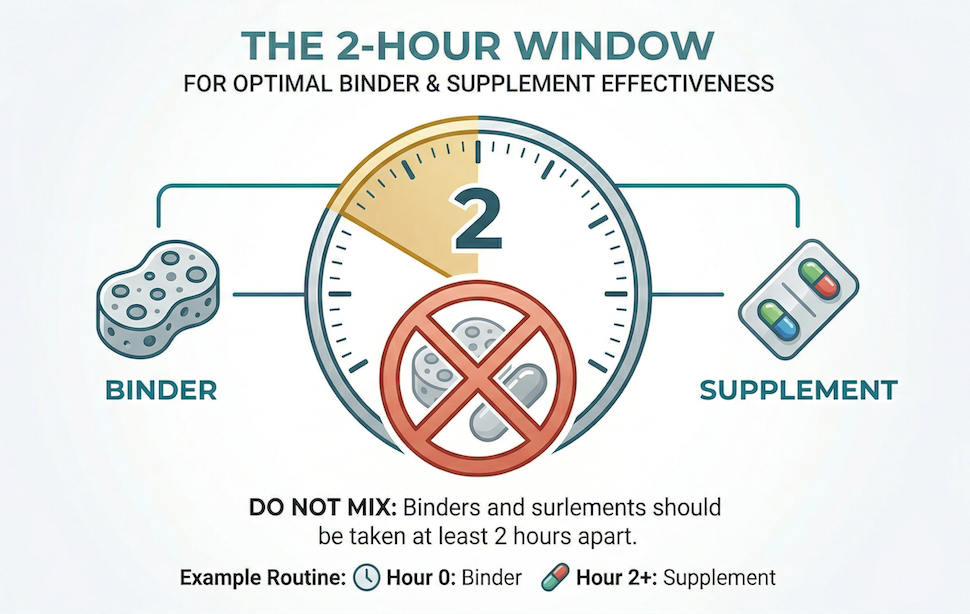
Clinical Timing: Always separate binders from nutrients and medications by at least 120 minutes to prevent malabsorption.
Regardless of which binder mechanism you select, honoring the 2-Hour Rule is essential. Because binding agents grab hold of compounds indiscriminately, taking them alongside meals or therapeutic supplements will cause nutrient malabsorption.
Integrating Binders into Your Protocol
First, confirm that your drainage pathways are active by following the Drainage Funnel Protocol. Second, select the appropriate binding agent from this guide to safely sweep circulating waste out of the body.
Sources & Clinical References
Peer-Reviewed Toxin Sequestration Research
- Activated Charcoal (Adsorption Mechanics): Derlet, R. W., & Albertson, T. E. (1986). “Activated charcoal—Past, present and future.” Western Journal of Medicine, 145(4), 493–496. [PubMed PMID: 3515814]. Foundation for non-selective organic chemical adsorption.
- Zeolite Clinoptilolite (Ion Exchange & Safety): Pavelić, S. K., et al. (2018). “Critical Review on Zeolite Clinoptilolite Safety and Medical Applications in vivo.” Frontiers in Pharmacology, 9, 1350. [PubMed PMID: 30538083]. Mechanisms of cage-trapping heavy metals and intestinal wall preservation.
- Bentonite Clay (Mycotoxin Sequestration): Moosavi, M. (2017). “Bentonite Clay as a Natural Remedy: A Brief Review.” Iranian Journal of Public Health, 46(9), 1176–1183. [PubMed PMID: 28848701]. Clinical efficacy for aflatoxin binding and mucosal support.
- Modified Citrus Pectin (Systemic Chelation): Eliaz, I., et al. (2006). “The effect of modified citrus pectin on urinary excretion of toxic elements.” Phytotherapy Research, 20(10), 859–864. [PubMed PMID: 16835878]. Demonstrated systemic mobilization and urinary elimination of lead and heavy metals.