

At a Glance: Bouncing Benefits for Lymphatic Drainage
- The Lymphatic Goal: Discovering bouncing benefits for lymphatic drainage helps clear stagnant fluid and boost everyday vitality.
- No Central Pump: Unlike your cardiovascular system, your lymph system lacks a heart to pump fluid. Consequently, it relies on physical movement and gravity to flush toxins.
- The G-Force Effect: Gentle vertical bouncing alters gravitational forces rapidly. As a result, one-way valves open to flush fluid through your lymph nodes.
- Whole-Body Health: Daily bouncing strengthens bone tissue, tones core muscles, supports immune defense, and protects joint health.
- Easy Options: You can experience bouncing benefits using mini-trampolines, vibration boards, exercise balls, or simple heel drops.
Exploring bouncing benefits for lymphatic drainage can transform your daily health routine. Today, modern desk jobs keep many people sitting for hours. Unfortunately, sedentary living causes fluid and metabolic waste to pool in tissues. Because your body lacks an automatic lymph pump, gentle bouncing offers a simple way to restart circulation.
When you bounce, rapid changes in gravity act as a natural siphon for your lymph nodes. Furthermore, research in exercise science confirms that vertical motion speeds up cellular repair. In this article, we explore key bouncing benefits for lymphatic drainage, evaluate equipment, and share an easy daily protocol.
Science Behind Bouncing Benefits for Lymphatic Drainage
To understand bouncing benefits for lymphatic drainage, we must look at how lymph fluid moves. Your body holds three times more lymph fluid than blood. However, lymph fluid must move upward against gravity without a heart to push it.
Specifically, your lymph vessels rely on tiny micro-valves. When you bounce on a soft surface, two physical forces happen at once:
How Bouncing Pumps Your Lymph Nodes:
- The Peak (Zero Gravity): At the top of your bounce, weightlessness pauses pressure. Consequently, lymph valves open to draw fluid into lymph node clusters.
- The Bottom (Increased Gravity): At the bottom landing, gravitational force increases gently. As a result, this pressure pushes fluid straight through your lymph nodes.
Indeed, famous research from NASA scientists shows that rebounding builds cellular strength efficiently. In addition, it protects joint tissue better than running on hard ground.

Key Bouncing Benefits for Lymphatic Drainage and Health
While flushing lymph nodes is a main goal, vertical movement aids your whole body. Below are the top evidence-backed gains of adding simple bouncing to your daily life.
1. Bouncing Benefits for Cellular Detoxification
Every cell dumps metabolic waste directly into surrounding fluid. When lymph flow slows down, toxic waste builds up quickly. Consequently, this buildup leads to swelling, brain fog, and fatigue. Fortunately, routine bouncing increases lymph flow velocity up to 15-fold. Therefore, cellular waste clears out before causing trouble.
2. Bouncing Benefits for Immune Defense
Lymph nodes act as filtering hubs packed with protective immune cells. By pumping fluid through these nodes faster, bouncing helps immune cells spot threats quickly. As a result, your body builds stronger daily immunity.
3. Bouncing Benefits for Bone Density
Bone tissue responds directly to gentle weight changes. When you land softly on a rebounder, mechanical pressure stimulates bone cells. Consequently, this natural signal helps build stronger bones without heavy spinal pressure.
4. Bouncing Benefits for Core and Pelvic Strength
Staying balanced while bouncing requires small, automatic muscle contractions. Thus, rhythmic movement gently tones your deep core and pelvic floor. In addition, it supports lower back stability during daily tasks.
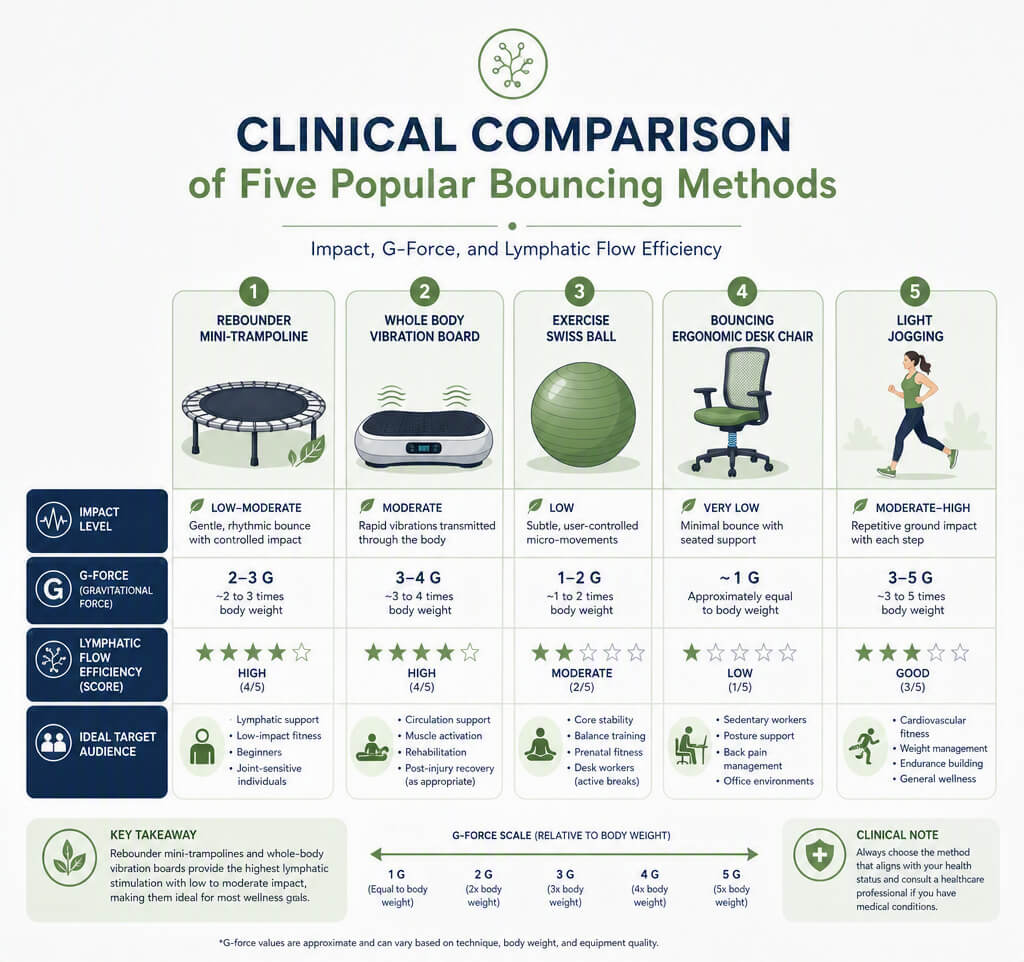
Equipment Comparison for Bouncing Benefits and Lymph Node Health
Fortunately, you do not need intense workouts to enjoy bouncing benefits for lymphatic drainage. Depending on your needs and budget, several convenient options exist today.
1. Rebounders (Mini-Trampolines)
Mini-trampolines with bungee cords provide the best home bouncing experience. Unlike metal springs, soft bungee cords absorb joint impact effectively. Therefore, they deliver deep lymph movement safely for all fitness levels.
2. Whole-Body Vibration Boards
Vibration plates use rapid platform movements to contract muscles automatically. Studies show that gentle vibration improves skin blood flow and moves stagnant fluid. Consequently, vibration plates work wonderfully for people with joint discomfort.
3. Exercise Balls (Swiss Balls)
Inflatable fitness balls offer an affordable way to bounce at your desk. Simply sitting upright and bouncing gently engages your lymph valves. Thus, it serves as a wonderful active sitting habit.
4. Bouncing Motion Chairs
Modern dynamic office chairs feature flexible bases that allow subtle vertical motion. While gentle, this continuous movement prevents fluid buildup in lower legs during long work sessions.
5. Light Jogging and Heel Drops
If you do not own equipment, free alternatives work well too. For example, try simple heel drops. Rise onto your toes and drop your heels gently. Consequently, this motion sends helpful vibrations upward through your lymph nodes.
Bouncing Equipment Comparison Chart
| Bouncing Method | Impact Level | Lymphatic Flow Efficiency | Best Use Case |
|---|---|---|---|
| Bungee Rebounder | Very Low Impact | Highest (Maximum Gravity Shift) | Daily 10–15 min detox sessions |
| Vibration Board (WBV) | Ultra Low Impact | High (Rapid micro-pumping) | Joint recovery and gentle drainage |
| Swiss Exercise Ball | Zero Impact | Moderate (Seated rhythm) | Active desk sitting and posture |
| Bouncing Chair | Zero Impact | Mild to Moderate | Preventing leg swelling while working |
| Heel Drops / Jogging | Moderate Impact | Moderate | Zero-cost equipment-free movement |
Step-by-Step Protocol to Maximize Bouncing Benefits for Lymphatic Drainage
To gain the best results, pair your routine with simple prep steps. Follow this daily 10-minute routine to maximize your bouncing benefits for lymphatic drainage:
10-Minute Daily Lymphatic Bouncing Protocol
- Hydrate First (1 Minute): Drink a glass of water with electrolytes. Proper hydration thins lymph fluid so it flows smoothly.
- Open Main Outlets (1 Minute): Massage your neck near your collarbone gently. Opening this outlet ensures fluid exits freely without causing pressure.
- Health Bounce Warm-Up (3 Minutes): Stand on your rebounder. Gently bounce up and down without lifting your feet. This soft movement opens lymph valves safely.
- Active Bouncing (4 Minutes): Increase your bounce slightly. Lift your feet gently or swing your arms to clear armpit and groin nodes.
- Cool-Down Breathing (1 Minute): Slow down your movement. Take deep belly breaths to compress deep lymph ducts and finalize drainage.
Detox Tip:
Remember, physical movement frees up stagnant waste, but organs must eliminate it. Therefore, make sure your liver and gut are open. Read our Drainage Funnel Protocol to support clear pathways. You can also explore formulas in our Natural Health Shop.
Integrating Bouncing Benefits into Your Daily Longevity Routine
Ultimately, harvesting bouncing benefits for lymphatic drainage works best in a full wellness routine. For instance, pairing morning rebounding with autonomic resets like bee humming for vagus nerve stimulation reduces stress while moving fluid.
Furthermore, active fluid movement flushes cellular debris released during autophagy induction and nighttime glymphatic clearance. By bouncing for just ten minutes daily, you build an enjoyable path toward lasting energy and health.
Peer-Reviewed Scientific References & Studies
- Bhattacharya, A., McCutcheon, E. P., Shvartz, E., & Greenleaf, J. E. (1980). Body acceleration distribution and O2 uptake in exercise on treadmill and trampoline. Journal of Applied Physiology, 49(5), 881-887. PubMed Study PMID: 7429911
- Gaspar, A. M., et al. (2019). Whole-body vibration exercise improves skin microcirculation and lymphatic movement in healthy individuals. Microvascular Research, 126, 103898. PubMed Study PMID: 31325453
- Olszewski, W. L. (2003). Contractile activity of human lymphatic vessels. Lymphatic Research and Biology, 1(2), 87-92. PubMed Study PMID: 15624320
- Castiglioni, P., et al. (2018). Hemodynamic responses to whole-body vibration and physical movement. Frontiers in Physiology, 9, 1273. PubMed Study PMID: 30283344
- Scallan, J. P., Zawieja, S. D., Castorena-Gonzalez, J. A., & Davis, M. J. (2016). Lymphatic pump function under physiological loading conditions. Physiology, 31(4), 261-269. PubMed Study PMID: 27252161